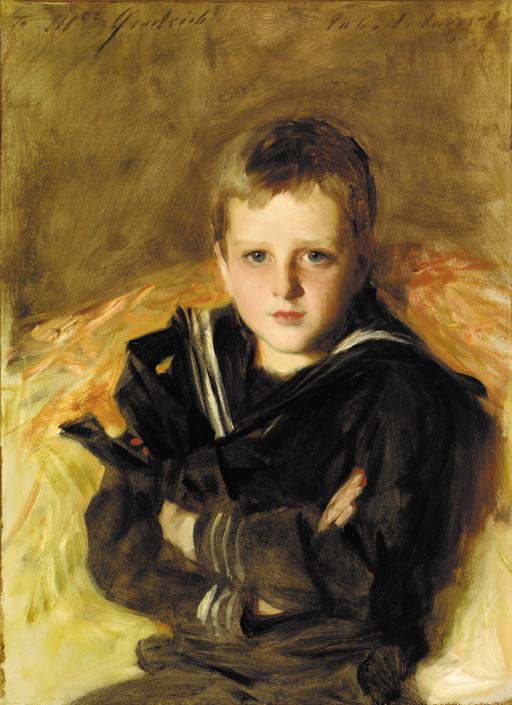
Portrait of
Caspar
Goodrich
John Singer
Sargent -- American painter
1887
Private
collection
Oil on
canvas
66.3 x
48.6
cm (26 1/8
x 19 1/8 in.)
inscribed
'To Mrs. Goodrich'
(upper left) and signed 'John S. Sargent' (upper right)
Jpg: Christies.com
From: Christie's
While all of
Newport
angled for a
meeting with the great European-bred artist, Sargent resided
comfortably
with his old friends, Admiral and Mrs. Caspar Goodrich, parents of the
young sitter. Charles Merrill Mount describes Sargent's arrival in the
United States: "He arrived at Torpedo Station huge and dominant,
smiling
and eager. It was years since he had seen the Goodriches, and since
those
peaceful days at Florence [Mrs. Goodrich] had borne a son, doubtless
one
day to enter the Navy, and a daughter, both of whom he would meet. It
was
pleasant to find friends in a strange place: Admiral Goodrich, who
still
spoke of the sea and ships as Dr. Sargent had. . . ." (John Singer
Sargent,
p. 106) Inscribed to the sitter's mother, it is presumed that Sargent's
portrait of Caspar Goodrich was not a commissioned work, but a token of
gratitude for the Goodrich's hospitality during the artist's stay.
Caspar Goodrich has
enjoyed a long
history of critical acclaim. In January 1888, shortly after it was
painted,
Caspar Goodrich was exhibited at Boston's St. Botolph Club along with
some
of Sargent's most celebrated pictures, including El Jaleo (Isabella
Stewart
Gardner Museum, Boston, Massachusetts) and The Daughters of Edward D.
Boit
(Museum of Fine Arts, Boston, Massachusetts). The show galvanized his
already
strong support by his American audience. Royal Cortissoz compared
Caspar
Goodrich favorably with some of Sargent's most celebrated pictures:
"This
likeness of a little boy in a sailor's suit is a charming
interpretation
of boyish character .... [in which] he has treated adolescence with the
most searching understanding." (as quoted in W.H. Downes, John S.
Sargent,
His Life and Work, Boston, Massachusetts, 1925, p. 150)
The six year old
Caspar
Goodrich
would have been an irresistible subject for Sargent. A beautiful young
boy with a peachy complexion and dark eyes, Sargent painted him wearing
a sailor suit, the most fashionable costume for a young boy throughout
the nineteenth century. Capturing the boy with arms crossed, gazing
directly
at the viewer, Sargent conveys the impression of both mischief and good
manners. Almost in spite of himself, a smile appears to be emanating
from
beneath the surface of the headstrong subject. Unlike their adult
counterparts,
Sargent's young sitters were unselfconscious and provided the artist
with
subject matter from which he derived some of his best work - enduring
portraits
that convey much more than the physical attributes of the subject.
Notes:
Provenance
Admiral and Mrs.
Caspar F.
Goodrich,
Newport, Rhode Island, parents of the sitter.
Eleanor Goodrich
Campbell
Davis,
New York, daughter of the above and sister of the sitter, by 1925.
By descent in the
family to
Eleanor
Brennan Jones, niece of the above.
Literature
'The Society of
American
Artists'
Exhibition,' Art Amateur, June 1890, p. 3
'American and European
Art
Notes,'
Art Interchange, 24 May 1890, p. 176
'Society of American
Artists,' New
York Times, 28 April 1890, p. 4 L. Mechlin, 'The Sargent Exhibition:
Grand
Central Art Galleries, New York,' American Magazine of Art, April 1924,
p. 185
W.H. Downes, John S.
Sargent: His
Life and Work, Boston, Massachusetts, 1925 (rev. ed. London, England,
1926),
pp. 149-150
E. Charteris, John
Sargent,
London,
England, 1927, p. 260
C.M. Mount, John
Singer
Sargent:
A Biography, New York, 1955, no. 8711, p. 431 (1957 ed., no. 8511, p.
340;
1969 ed., no. 8511, p. 440)
D. McKibbin, Sargent's
Boston, with
an Essay & a Biographical Summary, Boston, Massachusetts, 1956, p.
98
T. Fairbrother, John
Singer
Sargent
and America, New York, 1986, pp. 135, 161
R. Ormond and E.
Kilmurray,
John
Singer Sargent: The Early Portraits, Complete Paintings, Volume I, New
Haven, Connecticut, 1998, no. 195, pp. 200, 259-260, illustrated
Exhibited
Boston, Massachusetts,
St.
Botolph
Club, John Singer Sargent's Paintings, January-February 1888
New York, Society of
American Artists,
Fifth Avenue Art Galleries, Twelfth Exhibition, April-May 1890, no. 157
Boston, Massachusetts,
Copley Hall,
Paintings and Sketches by John S. Sargent, February-March 1899, no. 27
Boston, Massachusetts,
Museum of
Fine Arts, Memorial Exhibition of the Works of the Late John Singer
Sargent,
November-December 1925, no. 26
New York, The
Metropolitan
Museum
of Art, Memorial Exhibition of the Work of John Singer Sargent,
January-February
1926, no. 19, illustrated
New York, Portraits,
Inc.,
Portraits
of Children, 1860-1960, April-May 1960, no. 51
Great
Expectations: John Singer Sargent Painting Children; 2004-2005
Sales:
Sold Christie's New
York;
11/29/2001;
Lot: 25; Sale number 9788; $1,546,000
- See the year
in
review 1887
|